

Earn €7,500 with Automatic Labels
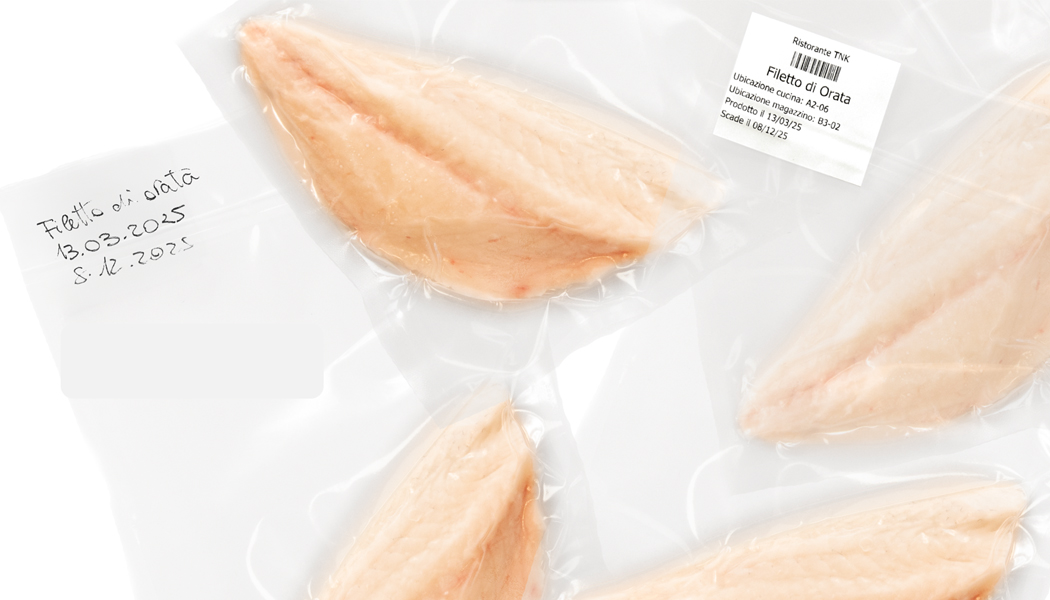
Writing by hand on containers and vacuum bags may seem like a minor task.
In our restaurant, by switching from handwritten labeling to automatic labeling, we save €7,500 every year.
You can do it too.
Read the article and discover how we achieved this result.
A marker. A bag. A few words: “ragù”, “cream”, “stock”, “sous-vide chicken”, and, at best, the preparation date. Rarely the expiry date.
It is quick, familiar and apparently practical.
It seems free.
But in a professional kitchen, and in a foodservice business, everything has a cost.
Especially repetitive tasks.
Perhaps in your restaurant too, every time a member of the kitchen brigade picks up a vacuum bag, writes the contents by hand, checks the date, adds notes, or corrects unclear handwriting, they are spending working time.
How much does it cost to keep handwriting labels on your prepared ingredients?
In the kitchen, work rhythms are intense: products to blast chill, store, regenerate, move and use across multiple services. Vacuum bags often look the same, and handwritten notes are made in a hurry, with dates that are difficult to read.
How often do you hear these questions in a restaurant kitchen?
“When was this made?”
“What does this label say?”
“How many portions are inside?”
“Why did we make the sauce again if it was already in the refrigerator?”
“Where are the carrots? Who used them all?”
Handwritten labeling can cause errors, wasted time, unexpected issues and stress.
In a kitchen operating with increasingly tight margins, even a few minutes repeated every day turn into hours. And hours become labor costs that could be dedicated to more important activities.
How We Save €7,500 Every Year
At the TNK restaurant, every day, for 300 working days a year, we spent more than one hour writing on bags containing prepared ingredients.
Multiply 300 hours by a labor cost of €25 per hour and you will discover that we were spending €7,500 every year just to write labels.
In a small kitchen. Can you imagine?
Automatic labeling of prepared ingredients has almost eliminated this time.
With the 300 hours saved, we avoided many overtime hours that our chefs would otherwise have had to work.
It was a major advantage, and not only from a financial perspective.
Now every label clearly displays:
- Product description
- Production date
- Shelf life
- Storage location inside the refrigerator
Each vacuum bag is immediately identifiable. Information no longer depends on handwriting, haste or the memory of the person on duty.
Much more convenient, much safer, much better organized.
A significant gain.
Managing Data in the Professional Kitchen
Do you know why we were able to achieve all this?
Because we developed an automatic system that prints labels, uses the data already stored in the recipe sheet and even alerts us when stocks of a prepared ingredient are running low.
This, and much more, is Qadra.
Qadra creates value from business data by connecting POS, orders and kitchen operations.
Prepared ingredient management no longer remains confined to the back kitchen. It becomes part of a broader operational logic involving sales, orders, production, availability, costs and organization.
Now every vacuum bag speaks the same language. Every container is recognizable. Every preparation includes clear information. Every member of the brigade can read and understand it, even if they did not take part in production or have just joined the team.
Why make your staff rewrite the same information every day when it only needs to be entered once into a simple software system?
This saves time and creates order. Two essential elements for efficient business management.
Saving Means Earning
When we opened our restaurant, we tried to reduce expenses, seeing savings only as costs that did not appear on an invoice.
But the real savings are often generated through daily operations: within the processes we can improve and the activities we perform automatically without questioning whether they could be done better, faster and more economically.
The advantage of automatic labels is exactly this: they eliminate part of the repetitive work.
We should take advantage of every available tool to eliminate inefficiencies.
Saving time means reducing costs, and reducing costs means generating indirect profit.
TNK professional kitchen equipment and technologies have been developed precisely with this objective in mind.
Printing a label is useful.
But printing a label within an integrated Ecosystem is far more powerful: it becomes part of the process.
Dimensional consistency, shared design, common technology and integration across every piece of kitchen equipment help make a foodservice business sustainable and profitable.
Would you like to increase your profits with the TNK Ecosystem?
Appointments and News
View all news
EROC Modular: the professional kitchen that saves...
Every professional kitchen wastes energy, before and during service. EROC reduces consumption by up...
Read more
Earn €7,500 with Automatic Labels
What is the real cost of handwriting labels on bags containing prepared ingredients? Discover how...
Read more
Do you use more than one App in the kitchen? You...
In professional kitchens there are many connected appliances: every product has its own App. But how...
Read more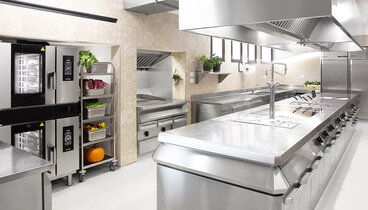
Does design matter in a professional kitchen?
Why do we still accept professional kitchens that look like they belong to the 1950s?
Read more
Food safety in professional kitchens
In professional kitchens, hygiene and food safety depend on many often underestimated factors....
Read more
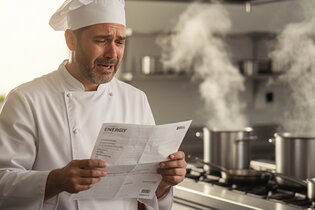
How to reduce energy costs in professional...
Energy costs are one of the most critical factors affecting a restaurant’s profitability. Discover...
Read more



Krupps joins the TNK group
TNK strengthens its offering with Krupps, the Italian leader in professional washing equipment.
Read more
Horeca Expo
From November 16 to 19 – Stand 5243 – join us at Horeca Expo in Ghent, Belgium.
Read more


TheNiceKitchen gets stronger
We are pleased to announce the investment in TheNiceKitchen by 21 Invest.
Read more
4 advantages of energy management with Balance
Experience shows that careful energy management is crucial for business. Our solution? It's Balance!
Read more
Small tricks for organising the kitchen
In a professional kitchen, organisation is crucial to ensure operational efficiency and maximise...
Read more

Which is the best oven?
There is no absolute best oven, and each technology must be chosen considering many aspects that...
Read more
Winning through teamwork
The best results are achieved when a team is close-knit even within a kitchen, discover the perfect...
Read more
The evolution is complete
The beginning of 2023 for Modular was full of novelties and changes: exciting projects took shape to...
Read more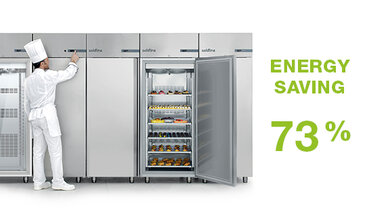
How much do you make with a Coldline cabinet?
Choose energy-saving refrigerators and freezers, with Coldline you save 73% in energy costs.
Read more
We design your successful kitchen
The success of a restaurant business is the sum of a mix of many factors that, properly balanced and...
Read more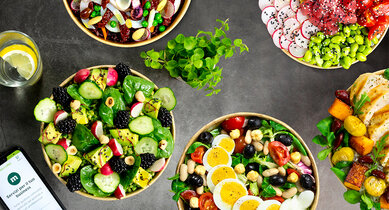
Does quality food delivery exist?
Is there such a thing as quality food delivery? In the Nice kitchen our challenge is to prove that...
Read more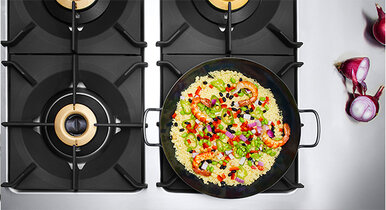
Roc: the best gas hobs
The gas cooker is something that every cook wants, handles with confidence and skill. Cooking and...
Read more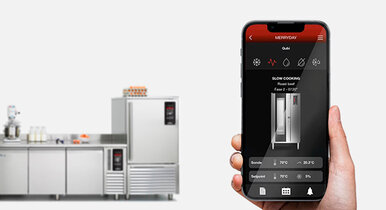
The connected and efficient kitchen
Ours is a hyper-connected reality: more and more devices are networked, exchanging data with each...
Read more
Delivery or service at the table?
Back to table service only or continue with home deliveries as well? A question that every...
Read more
New Modi Active GN2/3 blast chiller
The Modi Active range of multifunction blast chillers expands with the new 3-trays GN2/3...
Read more
How to produce small and large leavened products
The technology to successfully organise, plan and manage small and large leavened products is called...
Read more