

Does design matter in a professional kitchen?
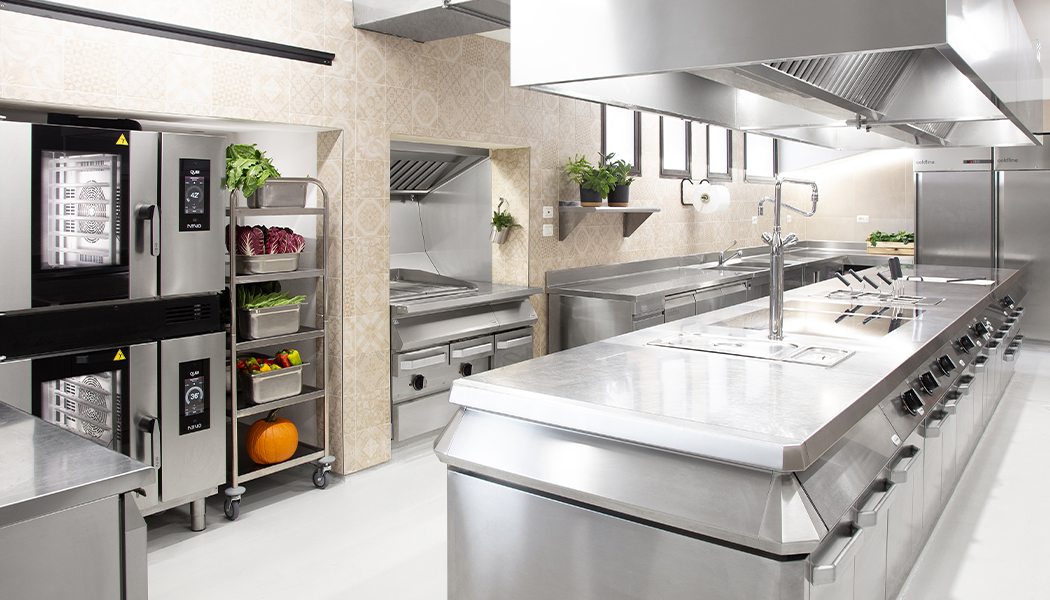
Think about our grandmothers’ kitchens.
Stove, table, refrigerator when there was one, cabinets… everything had different colors, shapes and finishes. It was a kitchen assembled from many separate pieces.
Now look at your home kitchen: built in appliances, base units at the same height, a single worktop, wall units matched with the bases, refined design. In two words: aesthetic consistency.
When you step into a restaurant kitchen, look around.
Observe work tables, oven, blast chillers, refrigerators, dishwashers.
What do you notice?
- Slightly different heights
- Misaligned depths
- Finishes that change from one module to another
- Different handles
- Plinths that do not match
- Feet that are not aligned
- Displays with non homogeneous graphics and operating logic
Does the kitchen work? Yes.
Is it efficient? Not always.
You find this situation in an “assembled kitchen”, while in a “designed and coherent kitchen” everything can be different.
So why do we accept that professional kitchens still resemble those of the 1950s?
In professional foodservice, multi brand installations are common. But the result is often a patchwork effect that is aesthetically unappealing and operationally inefficient.
Assembling different pieces creates many small operational issues that emerge over time, often too late, when the kitchen is already installed and the brigade has to adapt to what they find.
From an aesthetic issue to an operational problem
The most common mistake is to think that uniformity is a matter of design, aesthetics or taste.
It is not. Let’s look at an example.
When refrigerated tables and static preparation stations are not aligned, this is what happens:
- Dirt accumulates in the gaps
- Cleaning becomes slower
- Operators bump into protruding edges, with the risk of tripping
- Accidental drops of containers, pots and trays become more frequent
And during service, when pace is high, everything is amplified.
A worktop that is slightly higher or deeper is not a detail: it is a constant obstacle, invisible but always present.
Imagine a preparation line with refrigerated tables and neutral tables during a busy service: every movement should be natural, automatic, fluid. If instead every step requires a micro adjustment, those seconds add up into minutes.
And those minutes become delays, discomfort and frustration for operators.
Over time, this means fatigue, slowdowns and loss of efficiency.
The problem does not stop in the kitchen. It affects business performance and overall sustainability.
Designing an efficient professional kitchen
When a kitchen lacks coherence, design and installation costs also increase.
Has it ever happened to you?
Design time increases
The risk of error is higher because each supplier follows different logic
Adjustments during installation increase
Last-minute changes multiply
Mistakes and oversights are always around the corner
Margins on the project are reduced
And above all: the customer perceives less value.
You gave your best, but excessive complexity undermined every effort.
When the system is not coherent, after-sales also becomes more complex. More suppliers, more fragmented responsibilities, more time spent understanding who is responsible.
Let’s add another key point: today’s restaurateur is not just looking for equipment.
They are looking for control, order and operational efficiency. They want a sustainable business, and the kitchen is a fundamental element.
How can these needs be met?
Designing coherent kitchens
The right question is not: “what is the best oven?”
But rather:
“how should this kitchen operate every day?”
“what menu does it need to produce?”
“how many people work in it?”
“how is the service organised?”
When you change perspective, the way you design the kitchen changes.
You no longer select individual products. You build a system where:
- Products are perfectly aligned
- Depths are standardised
- Work surfaces are continuous, preferably with a single top
- Cooking modules, refrigerated bases and neutral tables are installed on masonry plinths
- Cooking, blast chilling and storage technologies communicate with each other
- You manage the kitchen through a single App
And above all, you create a system that remains consistent over time, even as it evolves with new additions.
Because a kitchen grows, changes and adapts to the business.
Coldline + Tuls: aesthetics and dimensions aligned
The integration between Coldline refrigerated tables and Tuls static preparation tables is based exactly on this principle of aesthetic consistency and functional efficiency.
It is a design choice that offers numerous advantages both to designers and to those who work in that kitchen every day.
The most important elements to consider?
Dimensional compatibility: perfectly aligned height and depth
Single worktop: no interruption between refrigerated tables and preparation tables
Consistent design: same visual identity, same design language
Shared feet height
No special solutions: fewer on-site modifications, a wide range of standard solutions that reduce the need for custom-made products. Modules integrate naturally.
Another advantage?
Long-term compatibility.
This is an often underestimated aspect during the purchasing phase: what happens after 2, 3 or 5 years?
Most kitchens evolve:
- New stations are added
- Equipment is replaced
- Workflows are reorganised
In a multi-brand kitchen, every change becomes a problem:
- Products need adaptation
- Worktops need modification
- The aesthetics keep changing
With a TNK system, the logic is different.
Aesthetic and dimensional consistency is maintained over time.
This means you can:
- Add a new Coldline refrigerated table
- Integrate new Tuls stations
- Extend the line while maintaining a distinctive and practical style
You can clearly see the benefits.
A cleaner, faster, more profitable kitchen.
The brigade works in a well-organised and pleasant environment, movements are smoother, time is reduced and errors decrease.
A tidy, coherent and clean kitchen increases the restaurateur’s confidence, improves staff attractiveness and strengthens the venue’s image.
It is not just about aesthetics. It is positioning.
And that makes a real difference.
Next time you design a kitchen, take a moment.
Look beyond the single product.
Ask yourself: is this kitchen really a system… or just a sum of parts?
Appointments and News
View all news
EROC Modular: the professional kitchen that saves...
Every professional kitchen wastes energy, before and during service. EROC reduces consumption by up...
Read more
Earn €7,500 with Automatic Labels
What is the real cost of handwriting labels on bags containing prepared ingredients? Discover how...
Read more
Do you use more than one App in the kitchen? You...
In professional kitchens there are many connected appliances: every product has its own App. But how...
Read more
Does design matter in a professional kitchen?
Why do we still accept professional kitchens that look like they belong to the 1950s?
Read more
Food safety in professional kitchens
In professional kitchens, hygiene and food safety depend on many often underestimated factors....
Read more
How to reduce energy costs in professional...
Energy costs are one of the most critical factors affecting a restaurant’s profitability. Discover...
Read more


Krupps joins the TNK group
TNK strengthens its offering with Krupps, the Italian leader in professional washing equipment.
Read more
Horeca Expo
From November 16 to 19 – Stand 5243 – join us at Horeca Expo in Ghent, Belgium.
Read more


TheNiceKitchen gets stronger
We are pleased to announce the investment in TheNiceKitchen by 21 Invest.
Read more
4 advantages of energy management with Balance
Experience shows that careful energy management is crucial for business. Our solution? It's Balance!
Read more
Small tricks for organising the kitchen
In a professional kitchen, organisation is crucial to ensure operational efficiency and maximise...
Read more

Which is the best oven?
There is no absolute best oven, and each technology must be chosen considering many aspects that...
Read more
Winning through teamwork
The best results are achieved when a team is close-knit even within a kitchen, discover the perfect...
Read more
The evolution is complete
The beginning of 2023 for Modular was full of novelties and changes: exciting projects took shape to...
Read more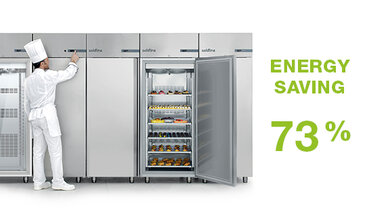
How much do you make with a Coldline cabinet?
Choose energy-saving refrigerators and freezers, with Coldline you save 73% in energy costs.
Read more
We design your successful kitchen
The success of a restaurant business is the sum of a mix of many factors that, properly balanced and...
Read more
Does quality food delivery exist?
Is there such a thing as quality food delivery? In the Nice kitchen our challenge is to prove that...
Read more
Roc: the best gas hobs
The gas cooker is something that every cook wants, handles with confidence and skill. Cooking and...
Read more
The connected and efficient kitchen
Ours is a hyper-connected reality: more and more devices are networked, exchanging data with each...
Read more
Delivery or service at the table?
Back to table service only or continue with home deliveries as well? A question that every...
Read more
New Modi Active GN2/3 blast chiller
The Modi Active range of multifunction blast chillers expands with the new 3-trays GN2/3...
Read more
How to produce small and large leavened products
The technology to successfully organise, plan and manage small and large leavened products is called...
Read more